Why agile?
Agile project management methods and tools offer valuable benefits
- when key factors and requirements are continuously changing, whether within your company or on the client side
- and when it's important to begin, even though objectives and the solution path are not yet fully defined
This is more relevant today than ever. Depending on the situation, approaches such as Kanban, Scrum, Design Thinking, or DevOps can be effective. However, methods alone aren't enough — the human factor is even more critical. External coaching can support the optimal application and further development of an agile working culture.
what is the strength of agile teams?
- The key point: You deliver - even in rough waters - without burning out.
- Agile teams operate in cycles, often limiting parallel tasks per rhythm. To stay adaptable in rapidly changing environments, they find innovative solutions by harnessing the collective intelligence of their team, clients, future competitors, and AI-powered support.
- The focus is on delivering early, usable outcomes - with optimization, where needed, as a second step.
- Clear agreements go hand in hand with the courage to embrace change - often described as an agile mindset.
- Agile thrives with motivated, empowered teams who value transparency and openness.
- Success rates are high - and if failure does occur, it tends to happen earlier and at a lower cost.
- Roles differ from traditional project management: a Product Owner continuously aligns priorities between the team and the customer, steering the direction of the project. The how—the way the solution is built - is determined by the entire team, with everyone on equal footing. The team is often guided and supported by a facilitator or coach, such as an Agile Coach, Scrum Master, or similar.
agile frameworks (examples)
(C) FM
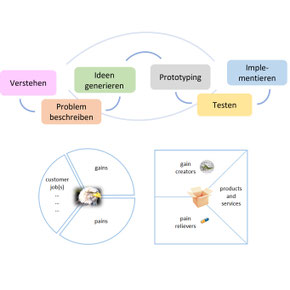
Design Thinking
Design Thinking unlocks what truly matters to your customers—turning deep insights into real competitive advantages.
Through alternating divergent and convergent phases, we transform complex challenges into breakthrough innovations. From understanding and prioritizing user needs to ideating, prototyping, and scaling successful products and services—Design Thinking delivers real results.
It’s a powerful approach for tackling complex innovation topics. By embracing early validation and fast feedback loops, you reduce risk, avoid costly missteps, and increase your chances of market success.
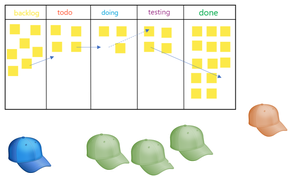
Kanban
The Kanban framework offers simple yet powerful practices for prioritizing initiatives and delivering results with short lead times.
Its universal applicability makes it suitable for everything—from personal task management, agile project teams, and strategic planning to executive-level tracking.
Key principles at a glance:
- Limit work in progress: Focus on completing work rather than starting too many tasks at once
- Finish over start: Flow efficiency comes from bringing work to the finish line
- Pull principle: Tasks are actively “pulled” by team members from a prioritized backlog—Kanban is not about assigning tickets!
(C) FM

(C) FM
Scrum
Scrum brings structure, speed, and self-organized teamwork to your projects.
Within a defined team size (typically 4 to 10 members), work is delivered in time-boxed cycles called Sprints - usually lasting 2 to 4 weeks. Scrum works best when projects can deliver tangible results in short iterations.
The roles in Scrum are clear and collaborative - not hierarchical:
- The Scrum Team works with a backlog based pull principle, same as at Kanban, here with Sprint-Cycles. Mid term, a certain rough planning is done on a less detailed level.
- The Scrum Master/Scrum Mistress facilitates the process and helps remove obstacles
- The Product Owner manages prioritization and represents the team toward stakeholders and customers
Each team member should contribute at least 30% of their working time to the Scrum team - otherwise, the high coordination effort involved in Scrum may not justify the investment.
Agile flight levels
aligning strategy and execution with clarity and flow.
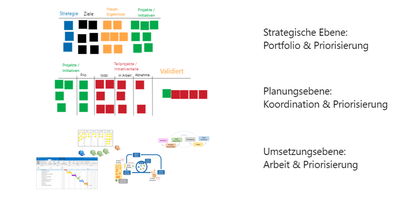
Imagine visualizing different organizational altitudes—each represented by its own Kanban board. Every level connects seamlessly to the next:
✈️ Strategic Level – defines strategy elements, goals, and initiatives 📍 Planning Level – translates initiatives into actionable projects 🔧 Operational Level – executes projects and tasks using team-specific methods
The real strength lies in this top-down and bottom-up alignment. Every task is clearly linked to strategic goals—allowing continuous validation and course correction. And strategic priorities reflect actual resource capacities.
Agile Flight Levels create transparency, boost strategic focus, and foster a culture of connected thinking across the organization.
(C) FM
Service - offering
Hands-on support and team development—tailored for distributed remote teams
I offer practical guidance as a Scrum Master or Agile Coach, typically available one to two days per week over a defined project period. Engagements are flexibly structured to match your needs:
- Full-day coaching sessions to support Sprint planning, stage transitions, and key milestones
- Shorter, distributed time slots focused on continuous team collaboration, Product Owner support, and optimizing agile collaboration for measurable results
- Strong focus on value & results
This format allows teams to stay focused, connected, and supported—without losing valuable momentum across time zones or locations.
Coaching & training for Product Owners, Scrum Masters, and line managers
My goal in every engagement is to empower teams to no longer depend on external support. I help them confidently apply what we've developed together—independently and sustainably.
For Kanban and Scrum teams, it’s especially effective to embed agile practices, tips, and techniques directly within team roles or adjacent teams. In my experience, this “side-role” setup fosters more resilience and long-term success than relying on specialized external roles. As a specialist, my involvement is intentionally temporary.
Scrum Master foundational training: For those stepping into the role alongside their daily responsibilities, we plan:
- 6×2h group sessions for guided learning
- 6×2h of individual work to deepen practical understanding
Participants are well prepared to take the PSM I certification upon completion.
Workshops and training sessions for exploring or deepening agile ways of working
We offer a concise overview of key agile methods—highlighting where each approach excels, and where it may not be the best fit, all illustrated through practical, real-world examples.
Building on this foundation, we identify what makes sense for your team and guide you through your first implementation steps.
💡 Workshop benefits:
- Immediate value and actionable insights
- Strengthens an agile team culture
- Avoids wasted resources and frustration by steering clear of mismatched methods
⏱️ Typical duration: starting from a full training day or two half-day sessions

Temporary support during agile transformations—customized to your starting point
If you're in the process of transitioning toward more agile operations, external guidance and unbiased feedback can be invaluable. It helps you avoid common pitfalls, spot missteps early, and collaboratively develop changes that fit your team and goals.
Support is tailored to your specific situation—designed to match your pace, structure, and transformation objectives.
With over ten years of experience shaping and supporting agile project teams across both IT and physical product and service development, I’m here to help optimize your team and cross-functional collaboration. As an ISO17024 certified Agile Coach and PSM II Scrum Master, my focus lies in hands - on work directly with teams. I frequently support teams operating across multiple locations, often facing challenges such as high remote ratios, shifted working hours, or limited availability. No matter the setup, my goal is to strengthen agile practices, enhance communication, and unlock the full potential of each team - tailored to your specific context.